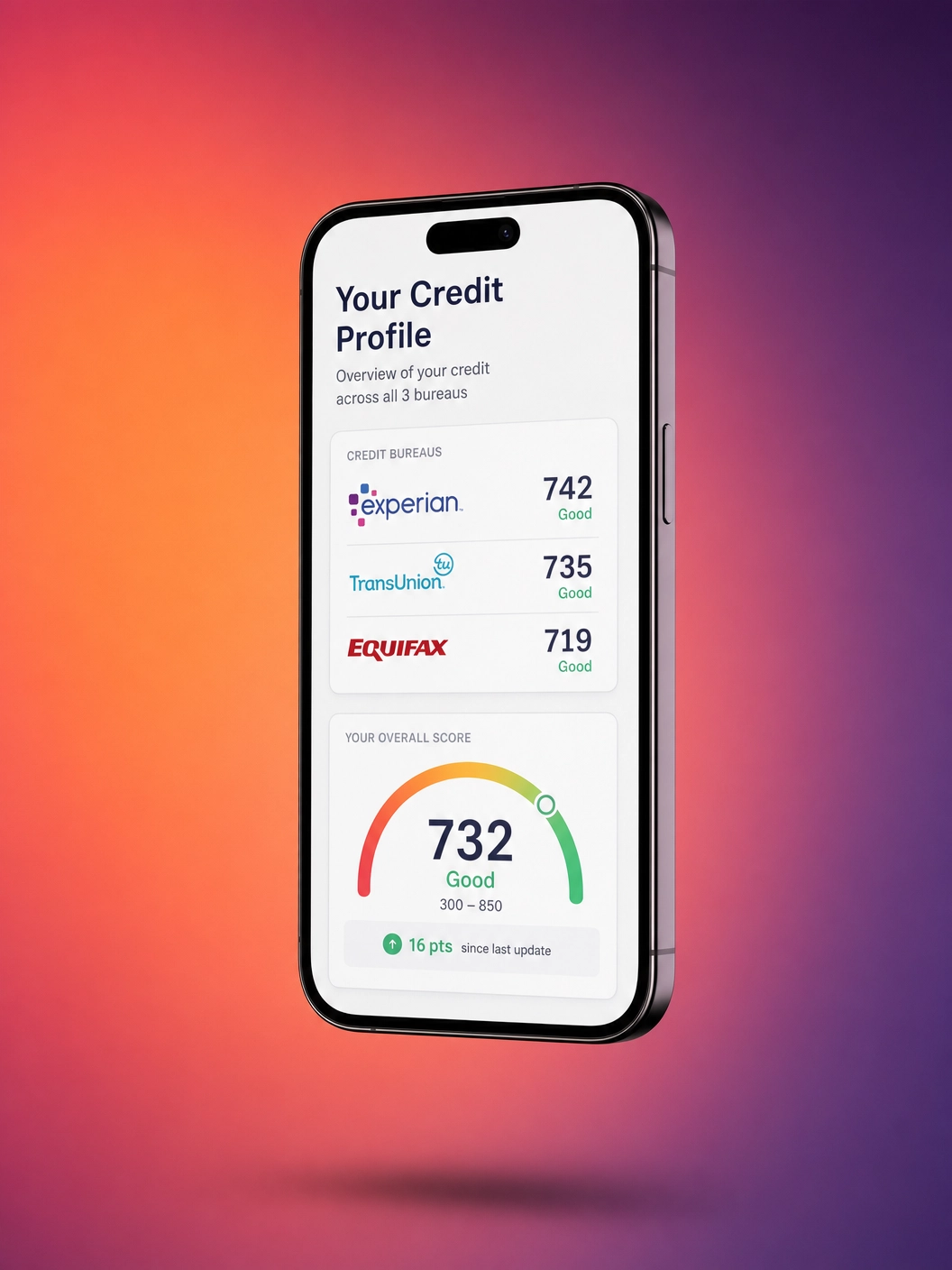
How to Glow Up Your Credit Score, Dump High Interest Rates, and Finally Attract the Financial Life You Deserve.
Nine chapters. Zero fluff. Everything you need to go from declined to approved, and stay there.
Everyone else seemed to know the secret handshake. Nobody told you the game had rules, let alone that you could win it.
The American credit system feels exactly like downloading a dating app with no instructions, no profile tips, and an algorithm that judges you before you've said a word. Nobody teaches this in school. You learn about credit the hard way: through rejections, high rates, and the slow realization that a three-digit number controls more of your life than you ever knew.
The cruelest part? The less money you have, the more the system charges you to borrow it. A 480 score on a car loan isn't just embarrassing. It costs you thousands more than the person sitting next to you with a 780. Same car. Different reality.
Lenders swipe through hundreds of applicants a day. Your score is the first thing they see. A great score is a glowing bio with verified photos. You get matches fast. A poor score is a blurry selfie with zero info. Swipe left before they even read the details.
"Credit isn't a measure of your worth as a human being. It's a measure of how profitable you are to a bank. Once you understand that, the game gets a whole lot easier to play."
Here is the good news: the game isn't rigged. It's just complicated. But the rules are knowable, the strategies are learnable, and the results are achievable. People with scores in the 400s climb to the 700s and 800s. It takes time and consistency, not magic, not money, not luck.
Stop thinking of your credit score as a verdict on your character. Start thinking of it as a game with rules you can learn. Every strategy in this book is a cheat code for playing that game better, starting today.
Equifax, Experian, and TransUnion are watching. They have been taking notes on your financial life for years.
Before any lender even glances at your profile, three companies have already built a complete dossier on your financial life. They are not government agencies. They are massive, for-profit data brokers that have been quietly collecting your information since the first time you borrowed money. Think of them as the mutual friends who know everything about you before your date even walks through the door.
Yes, actually. There are dozens of specialty credit agencies out there. Innovis is considered the fourth major one and is used by some lenders for fraud screening. ChexSystems tracks your banking history and is what banks check before opening a new account for you (yes, that is a separate report entirely). LexisNexis, PRBC, and others exist for specific industries like insurance and rental housing. So why are we focusing on just the Big Three? Because Equifax, Experian, and TransUnion are the agencies that the overwhelming majority of lenders, landlords, and employers use when making decisions about you. They hold the most weight, they have the most data, and fixing your profile with them will move the needle the most. Master these three first. The others are bonus rounds.
One of the oldest credit reporting agencies. Also offers identity protection services. Pull your Equifax report in January.
Offers free monitoring & the Experian Boost tool. Pull your Experian report in May.
Known for employment data & tenant screening products. Pull your TransUnion report in September.
These are private companies that profit by selling your data to lenders, landlords, and employers.

They remember every late payment, every time you maxed a card, every application you ever made. They don't care about context. They just report the data. Your job is to make sure they're reporting it accurately.
Your credit report is the raw story: every account, every payment, every inquiry, every public record. Your credit score is the numerical summary: a single number between 300 and 850 derived from that story. Change the data, and you change the number.

By law, you're entitled to a free report from each credit reporting agency at AnnualCreditReport.com. Pull Equifax in January, Experian in May, and TransUnion in September. Three free checks spread across the year, giving you effective year-round monitoring at zero cost.
AnnualCreditReport.com gives you the free version: reliable, solid, no frills. But if you are actively repairing your credit, you might want something watching your back 24/7. Credit monitoring services give you real-time alerts when something changes on your report, daily score updates, identity theft protection, and sometimes all three agency reports in one place. During your credit repair season especially, this kind of visibility is worth its weight in gold.
Some popular options to consider:
IdentityIQ: comprehensive monitoring with all three agencies and identity theft insurance.
MyFICO: the gold standard if you want to see the actual FICO scores lenders use, not just VantageScore estimates.
MyScoreIQ: solid three-agency monitoring with dispute assistance tools.
Experian (paid tier): adds dark web monitoring and score simulators.
Pricing typically starts around $29/month and goes up depending on features. Is it required? No. Is it smart when you are actively working on your credit? Absolutely. Think of it as having a devoted partner who never sleeps, never forgets, and whose entire personality is protecting your credit score. Honestly, relationship goals.

How a single three-digit number gets calculated, and what it actually means for your financial love life.
FICO and VantageScore are the two main scoring models. Think of them as two different dating apps that read your same profile and assign a rating. FICO dominates, used by roughly 90% of top lenders, so it is the one that matters most. Both use the same 300–850 range. Here is what each tier actually means when you show up to the financial table.
Lowest rates, best rewards cards, lenders competing for your business. The VIP section of finance.
Prime rates, great terms, more choices. Lenders want your business and show it with better offers.
Most lenders approve you at competitive rates. Life gets noticeably easier in this range.
More approvals but above-average rates. You're in, but not at the good seats. Yet.
Frequent rejections, punishing rates, and limited options. But this is a starting point, not a life sentence. People climb from here to the 700s all the time.
"The difference between a 620 and a 760 isn't bragging rights. It's tens of thousands of dollars over the life of a mortgage. That's not a rounding error. That's a college education."
Your score has five dating dealbreakers. Know what they are looking for and you will never get left on read again.
FICO calculates your score using five factors, each weighted differently. Think of them as the five sections of your dating profile. Your main photo matters more than your bio. Your bio matters more than your Spotify playlist. Neglect the big ones and no amount of clever answers to icebreaker questions will save you.
Have you paid on time? One missed payment drops a good score by 60–110 points overnight. This is your main photo. It is everything.
How much of your available credit are you using? Keep it under 30%. Under 10% is ideal. High balances scream financial stress to lenders.
How long have your accounts been open? Older accounts show a longer track record. Never close old cards without a good reason.
Cards (revolving) + loans (installment) = a well-rounded borrower. Don't open accounts just to diversify though. The gain is modest.
Applying for 5 cards in one month looks desperate. Hard inquiries ding your score slightly and stay on your report for 2 years. Apply strategically.
Set up automatic minimum payments on every account. Not the full balance, just the minimum. This guarantees you never miss a payment by accident. Then manually pay the rest whenever you're ready.
No credit history isn't a dead end. It's a blank slate. Here's how to build a profile lenders want to swipe right on.
Starting from scratch, or rebuilding after a financial disaster, is less like starting over and more like setting up a brand new profile. You have no photos yet, no reviews, no history. But here is the thing about a blank profile: it is full of potential. The tools to fill it in are more accessible than most people realize, and the path from "no credit" to "great credit" is a lot shorter than you think.
Put down a cash deposit that becomes your credit limit. The minimum to get started is usually $200 to $500, and yes, that works to build your history. But here is the part most people skip: aim for at least $2,000 if you can swing it.
Why does the deposit amount matter beyond just utilization? Because when you are ready to apply for unsecured credit cards, auto loans, or other products, lenders do not just look at your score. They look at your existing credit limits to gauge how much responsibility you have already been trusted with. A lender considering giving you a $5,000 credit card will feel a lot more comfortable if you already have a $2,000 limit than if your entire credit history is built on a $300 secured card. Higher limits signal that someone, somewhere, already trusted you with real money. It is social proof for your wallet.
Use it for small purchases only, pay it in full every month, and after 6 to 12 months most issuers will upgrade you to an unsecured card and return your deposit. Look for cards that report to all 3 agencies, have low annual fees, and have a clear upgrade path.
You make monthly payments into a locked savings account. When the loan term ends, you get the money back. You are essentially paying yourself while building payment history at the same time. It is one of the cleanest credit-building tools available because it forces discipline and rewards you for it.
Where to find them: credit unions are the classic option and often have the best rates. For online options, Self is the most well-known and beginner-friendly. CreditStrong is another excellent choice, offering both installment accounts and revolving accounts specifically designed to build credit, with flexible payment amounts and terms. Both report to all three major agencies. If you want to build faster, running a secured card and a credit-builder loan simultaneously covers two of the five scoring factors at once: utilization and payment history.
Get added to a trusted person's oldest card. Their entire account history, including age, limit, and payment record, can appear on your report. Your score can jump significantly in 1–2 billing cycles. You do not even need to hold the physical card.
Important: The Amex Exception
If the account you are being added to is an American Express card, stop and read this carefully. Amex does not transfer the account's history to authorized users the way most other issuers do. When an Amex account appears on your report, it will typically show the date you were added as the open date, not the original account opening date. That means you lose the age benefit entirely. A 12-year-old Amex card will show up on your report as if it was opened last month. That is a significant trade-off.
Now, Amex cards are known for high limits, so if your primary goal is to boost your available credit (which helps utilization), being added to an Amex can still help with that specific factor. But if you are trying to build credit age, which is one of the most powerful long-term factors, an Amex authorized user account will not give you that.
The ideal setup? Two authorized user accounts: one non-Amex card with at least 7 years of age and a limit of $10,000–$15,000 or more (for both the age and the limit benefit), and if a second card is available, another non-Amex with similar history. If the only high-limit option available is Amex, you can use it for the limit boost while finding a separate older non-Amex account for the age benefit. Think of it like dating two people with very different strengths. One has the history. One has the money. Ideally, you find someone with both.
Here is something most people do not know: you are probably already paying bills every month that are not showing up on your credit report at all. Rent, utilities, phone, streaming services. None of these appear on your report by default, which means years of on-time payments are going completely uncredited. There are tools that change that.
Experian Boost (Free): The most accessible option. Connect your bank account and Experian will add your utility, phone, and eligible streaming payments to your Experian file. It only affects your Experian report, but it is free and takes about five minutes. A solid first step for anyone with a thin file.
RentReporters / Rental Kharma / Boom: If you pay rent, these services report your on-time rent payments to one or more of the major agencies. Rent is often your largest monthly payment and one of the most consistent. Having it on your report can meaningfully boost your score, especially if you have limited other history. Fees vary by service, typically $5–$10/month or a one-time setup fee.
Experian RentBureau: Some property management companies already report to this directly. Ask your landlord if they participate.
UltraFICO: A newer program that factors in your banking behavior, specifically your average bank balance and history of avoiding overdrafts, into a supplemental score. Not universally used yet, but worth knowing about.
None of these are magic bullets on their own, but stacking several of them together can make a real difference when your file is thin. Every positive data point you add is another reason for a lender to swipe right.
Late payments, collections, charge-offs. Your financial history has receipts. Here's how to deal with them like an adult.
Most negative items, including late payments, collections, and charge-offs, stay on your report for 7 years. But here is what nobody tells you: their impact fades dramatically over time. A collection from 5 years ago is like a bad ex your friends barely remember anymore. It is technically still in the history, but it is not running the show. Recent behavior matters most. The credit system is far more interested in who you are today than who you were back then.
Stay on report 7 years · Impact drops significantly after 2 years · Your score cares most about the last 12–24 months
Stay 7 years from original delinquency · Score impact diminishes after 2–3 years · Negotiate pay-for-delete BEFORE paying
7 years on report · Bankruptcy impact reduces after 3–4 years · Still manageable with consistent positive behavior
10 years on report · Impact reduces significantly after 4–5 years · Not the end. People rebuild from this
Stay 7 years from the date of repossession · Both the original account and the deficiency balance (what you still owe after the sale) can appear · Severely negative, especially in the first 2–3 years
Stay 7 years from the date of first missed payment · One of the most damaging single events to a credit profile · Recovery is possible but requires consistent positive behavior over several years
Unpaid child support can be reported as a collection account or public record · Stays 7 years · In some states, it can also affect your ability to renew a driver's license or professional license, making it a double hit worth addressing urgently
Stay on report 2 years · Only affect your score for the first 12 months · Multiple inquiries for the same type of loan (mortgage, auto) within a 14–45 day window are typically counted as one
Studies show a significant portion of credit reports contain errors. Under the FCRA, you can dispute anything inaccurate. The agency must investigate within 30 days and remove anything unverifiable. Do this in writing and keep copies of everything.
Pro tip for disputing: Use a credit monitoring service like IdentityIQ, MyFICO, or MyScoreIQ that shows all three agencies' data on a single dashboard. When you are disputing, you need to know whether an error appears on one agency's report or all three, because you will need to file separate disputes with each agency that is reporting it incorrectly. Seeing all three side by side on one screen saves you hours of cross-referencing and makes sure you do not miss anything.
Contact a collection agency in writing and offer to pay, but ONLY if they agree in writing to delete the account entirely from your report. Get that agreement before sending a single cent. Collection agencies typically purchase debt for pennies on the dollar, so they are often motivated to negotiate.
Before you go straight to pay-for-delete, check this first: Under the Fair Debt Collection Practices Act (FDCPA), collection agencies are required to follow specific rules about how and when they can contact you, what they can say, and how they must respond to disputes. If a collection agency has violated any of those rules, such as contacting you at prohibited times, using abusive language, misrepresenting the debt, or failing to validate the debt when asked, you may have grounds to have the account removed entirely without paying anything. This is not a loophole. It is your legal right. Review the collection account carefully, request debt validation in writing, and check for any FDCPA violations before negotiating payment. Pay-for-delete is a solid strategy, but disputing on legal grounds first costs you nothing and could get the same result.
Let's be clear about something important, because this space gets lumped together unfairly. There is a real difference between a predatory scam operation and a legitimate, law-abiding credit repair professional.
The red flags of a scam: Any company that promises to remove accurate, verifiable negative information from your report is lying to you. No one can legally do that. If they tell you to dispute everything on your report regardless of accuracy, or suggest you create a new credit identity using an EIN instead of your SSN, walk away immediately. Those are federal crimes.
What a legitimate credit consultant actually does: A reputable credit repair professional works within the law. They review your reports for genuine errors, inaccuracies, and unverifiable items, then dispute those on your behalf using the FCRA and FDCPA. They educate you on your rights, help you build a strategy, and hold you accountable. A legitimate consultant will be transparent about their fees, provide a written contract outlining exactly what services you are paying for, and they will never promise outcomes they cannot guarantee. Think of them as a wingperson who knows exactly what lenders are looking for, not someone swiping on your behalf and pretending to be you.
This book gives you the knowledge to do much of this yourself. But if your situation is complex, your time is limited, or you simply want an expert in your corner, working with a legitimate credit consultant is a smart and completely valid choice. Read their contract carefully and check CFPB (consumerfinance.gov) for guidance on your rights and what to look for.
The real-world dollars-and-cents price of a low credit score. Because this isn't abstract. It's your money.
Imagine two people going on the exact same date, same restaurant, same menu, same everything. One walks out paying $40. The other pays $180. Same experience. Wildly different bill. That is your credit score in action. Walk into a dealership with an 800 score and you might secure 5–6%. Walk in with a 550 and you could pay 20%+. On the same $30,000 car. On the same day. The math below is why your credit score is not a vanity metric. It is a price tag.
| Credit Score | Est. Rate | Monthly Payment | Total Interest | Status |
|---|---|---|---|---|
| 750+ | ~5.5% | ~$641 | ~$8,460 | |
| 700–749 | ~7.5% | ~$668 | ~$10,080 | |
| 660–699 | ~10.5% | ~$711 | ~$12,660 | |
| Below 620 | ~20%+ | ~$860+ | ~$21,600+ |
| Credit Score | Est. Rate | Monthly Payment | Total Interest (30yr) | Status |
|---|---|---|---|---|
| 760–850 | ~6.5% | ~$2,212 | ~$446,000 | |
| 700–759 | ~6.75% | ~$2,270 | ~$467,000 | |
| 660–699 | ~7.25% | ~$2,389 | ~$510,000 | |
| 620–659 | ~7.75% | ~$2,510 | ~$554,000 |
That's a $108,000 difference between excellent and fair credit on a mortgage. That's a college education. A decade of retirement contributions. A second property. Gone. Not because you did something dramatically wrong, but because you didn't know the rules of the game. Now you do.
You've got the basics down. Now let's accelerate. These are the moves that separate slow drifters from active engineers of their credit.
You have done the basics. You are paying on time. You are keeping utilization low. You are basically a solid 7 on the credit apps. But you are not here to be a solid 7. You are here to be the person everyone swipes right on. These advanced strategies are how you go from "pretty good" to "genuinely impressive." These are the moves the top scorers use, and most people have never heard of them.
Make one payment 15 days before your statement closes, and another 3 days before. Even if you use the card heavily all month, this ensures your reported balance is near zero when the lender reports to the agencies, keeping utilization in the single digits.
If you carry $200 on a $1,000 limit, that's 20% utilization. If the limit rises to $3,000, it drops to 6.7%, without changing your spending. Request increases every 6–12 months after responsible use. Always ask if it's a soft or hard pull first.
Avalanche: Pay highest-interest balance first. This saves the most money long-term.
Snowball: Pay smallest balance first. This builds psychological wins and momentum.
For your credit score, avalanche wins. But the best method is the one you'll actually stick to.
If you're applying for a mortgage and recently paid down balances or resolved a dispute, ask your lender about rapid rescoring. They can submit updated info to the agencies and get a new score within days rather than waiting for the monthly cycle. Only available through lenders, not consumers directly.
A soft inquiry (checking your own score, pre-qualification, employer check) = zero impact. A hard inquiry (formal application for credit) = small temporary dip. Always try to get pre-qualified with a soft pull before formally applying for anything. When rate-shopping for mortgages or auto loans, multiple hard pulls in a 14–45 day window count as just one inquiry.
"The best credit score isn't the one you wait for. It's the one you actively build. Every month of strategic behavior is another point in your direction."
The internet is a swamp of terrible financial advice. Let's take out the trash, myth by myth.
Your cousin who "knows about credit." The TikTok guy with 2 million followers and zero credentials. The friend who swears they paid off a collection and their score jumped 200 points overnight. Well-meaning people have been spreading credit mythology for decades, and it is costing real money. Time to unmatch from every single one of them.
Absolute myth. Checking your own score is a soft inquiry with zero impact. This fear has scared millions away from monitoring their credit, which is the opposite of what you should do. Check as often as you want.
This one deserves a real answer, not a dismissal. The oversimplified version says "always pay in full, carrying a balance is a myth." But the full picture is a little more interesting.
Here is what FICO actually does: if every single one of your credit cards reports a $0 balance, some scoring models will apply a small penalty because it looks like you are not actively using your revolving credit. The sweet spot, according to scoring research, is a utilization rate between 1% and 9%, not zero. That is a real distinction.
So what does that mean practically? You do not need to carry a balance and pay interest to build credit. What you need is for at least one card to report a small balance when the statement closes. You can pay it off in full the next day and never pay a cent in interest. The key is the balance that reports, not the balance you carry month to month.
The "carry a balance" advice people pass around is technically a misunderstanding of this mechanic, but it is not entirely made up. Someone who goes from 0% utilization to 1-9% utilization can absolutely see a score jump. The lesson is not "carry debt." The lesson is: let a small balance report on statement day, then pay it in full. You get the scoring benefit without the interest. That is the real move.
Closing an old card feels satisfying, like deleting an ex's number. But unlike deleting an ex's number, this one actually hurts you.
Here is why: when you close a card, you lose that card's available credit limit. That immediately raises your utilization ratio, which is the second-biggest factor in your score. And if it was an old account, you also chip away at your average account age over time, which is another scoring factor.
The only time closing a card makes sense is if it carries an annual fee that is not worth it, or if it is genuinely tempting you into debt. Otherwise, keep it open. Put a small recurring charge on it, like a streaming subscription, set it to autopay, and let it quietly do its job in the background. An open card with a $0 balance is a gift to your utilization ratio. Do not throw it away.
The credit agencies have absolutely no idea what you earn. Your salary, your bonuses, your side hustle income, your inheritance, your lottery winnings, none of it touches your credit score. Not one point.
This surprises people because it feels like wealth and creditworthiness should be the same thing. They are not. A surgeon earning $400K who misses payments and maxes out cards can have a 480. A teacher earning $38K who pays on time and keeps balances low can have an 820. Credit scores measure one thing: how reliably you manage borrowed money. That is it. Income is not in the formula.
The flip side? This is actually good news. You do not need to earn more to fix your credit. You just need to manage what you already have more strategically.
This is one of the most expensive misconceptions in credit repair. Paying a collection does not make it disappear. It just changes the label from "unpaid collection" to "paid collection." The negative mark still sits on your report for 7 years. You paid the debt and still got nothing removed. That is a bad deal.
The smarter move is to negotiate deletion before you pay a single dollar. Contact the collector in writing and ask for a pay-for-delete agreement: they agree to remove the account from your report entirely in exchange for payment. Get that agreement in writing, signed by someone with authority, before you send any money. If they say no, you can still evaluate whether paying is worth it for other reasons, but at least you tried the right way first.
One important note: not all collectors will agree to this, and it is not guaranteed to work. But it costs you nothing to ask, and the upside is significant.
This is the myth that keeps the most people stuck, and it is completely false. Every single negative item on your credit report has a legal expiration date. Late payments, collections, charge-offs, repos, all of them age off after 7 years. Bankruptcies take up to 10 years. And here is the part that matters: you do not have to wait for them to disappear to see your score improve.
New positive behavior starts outweighing old negatives within 12 to 24 months. The credit scoring models are forward-looking. They care much more about what you have done recently than what happened years ago. People climb from the 400s to the 700s all the time. It is not rare. It is not magic. It is just time plus consistency.
The only thing that makes bad credit permanent is deciding it is permanent. That is the real myth.
You have swiped through all the knowledge. Now it is time to actually go on the date. Here is your exact roadmap for the next 90 days, broken into phases that build on each other and actually feel doable.
This is not a vague "improve your credit" checklist. This is a sequenced, phase-by-phase action plan where each step sets up the next one. Think of it as a three-month relationship arc: Phase 1 is getting to know each other, Phase 2 is addressing the red flags, Phase 3 is building something real. Work through them in order. Check them off. Track your score monthly. The results will follow.
"Ninety days from now, you will either have started or you will wish you had. The credit system doesn't wait for you to feel ready. Start imperfectly. Adjust as you go. The only wrong move is no move."
The people who transform their credit aren't smarter or luckier. They're consistent. They track their progress. They don't quit after one setback. That's it. That's the whole secret.
The credit system is not your enemy. It never was. It is a game with rules, and now you know them. You know who is keeping score, how they calculate it, what tanks it, what heals it, and exactly what it costs you when it is low. You walked in here without a roadmap. You are leaving with one.
With inflation still biting, interest rates still elevated, and the cost of everything still climbing, your credit score is one of the most powerful financial levers you have. It is the one thing you can actively control when so much else feels completely out of your hands. A better score is not just a number. It is lower payments, more options, and more freedom.
You deserve to get approved. You deserve the best rate. You deserve the house, the car, the card with the good rewards and the lounge access. None of that is reserved for people who were born knowing the rules or who had a perfect financial upbringing. It is for anyone willing to learn the game and play it consistently. That is you now.
Now go get your match.
Two ways to make this real: expert-guided with BridgeCross Consulting today, or self-guided with the Scored app, coming soon, which will give you a separate AI-powered Blueprint for each credit reporting agency, monthly progress tracking, and a full action plan. Both paths lead to the same destination.
You've got the knowledge. But sometimes you need a guide who's walked this road a thousand times. BridgeCross Consulting provides hands-on, personalized credit repair and optimization services, so you are not doing this alone.
The companion app to this book, coming soon. It will let you upload your Experian, Equifax, and TransUnion reports and get a fully separate AI-powered Blueprint for each, showing exactly what gaps stand between your current profile and the score you need. You will be able to track your progress month by month, customize your targets, and share your plan with a BridgeCross consultant when you are ready for expert guidance.
The terms you will encounter on your credit journey, written in plain English with no jargon.